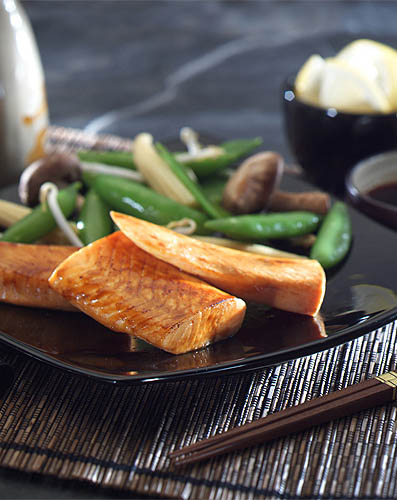
The shelf life of frozen salmon nine(9) months under commercial cold storage conditions. However, if properly stored at -18ºC (0ºF) with protection from exposure to air and dehydration, the actual shelf life of frozen salmon can be up to 12 months without quality loss.
There are many different yet easy ways to prepare C. Wirthy salmon: Bake, BBQ, microwave, and salmon is great as an entree. C. Wirthy salmon can be prepared easily for lunches or dinners. We have included a number of recipes on this site.
C. Wirthy Salmon is farmed in the southern coastal fjords of Chile. With the help of six meter tidal fluctuations and the Humbolt currents from Antarctica, Chilean raised salmon grow in the purest waters on earth. The salmon are fed a diet of fish components and oils in the form of pellets, from which they obtain their Omega-3s.
Levels of methyl mercury in salmon appear to be minimal to non-existent. Farmed salmon have shown even lower levels of methyl mercury than wild fish because of the high quality of feed.
With all the press concerning PCBs, is farm-raised salmon safe to eat?
Unfortunately, PCBs are found throughout the environment. However, research done by the FDA and independent laboratories have shown that levels of PCBs in salmon are 40 to 200 times lower than the FDA tolerance level. C. Wirthy salmon is shown to have .0095 or less parts per million. This means a 6 oz. serving of C. Wirthy salmon has fewer PCBs than a glass of milk.
Omega -3s, are essential fatty acids that our bodies cannot create without first obtaining them from certain foods. Omega-3s are highly polyunsaturated fatty acids that have been known to lower triglycerides, reduce abnormal heart rhythms, reduce blood pressure and improve blood clotting function. Omega-3s have also shown promise in the prevention and treatment of certain cancers and inflammatory conditions, such as rheumatoid arthritis. It has similarly promising results in the ability to relieve depression. The American Heart Association and the American Diabetes Association advocate eating
fatty fish, such as salmon as a safe way to obtain heart healthy benefits of Omega-3s.
Does eating farmed salmon have the same health benefits as wild salmon?
Farmed salmon have Omega-3 fatty acid levels similar to those in their wild counterparts. However, some researchers believe that because of their quality of food, farmed salmon may have a higher level of Omega-3 than wild salmon.
Certification Answers
What is the Global Aquaculture Alliance (GAA) and Best Aquaculture Practice (BAP)?
The Global Aquaculture Alliance (GAA), Best Aquaculture Practice is an international, non-profit trade association dedicated to advancing environmentally and socially responsible aquaculture. The Alliance was founded in 1997 with 59 members in the Americas, Europe and Asia. It now comprises 1100 members in 70 countries and has become the most prominent industry organization representing the global aquaculture business (www.gaalliance.org).
Food retailers (and wholesalers) regularly make audits to check the food safety aspects of their suppliers of own branded food products. These audits are made by independent auditors from qualified bodies.
With more than 11,000 certificates, standards translated into 20 languages and 800+ auditors IFS Food is one of the largest food safety and quality standards worldwide.
Initially established in 2003, the International Food Standard has continuously developed into an internationally recognized umbrella brand now called International Featured Standards (IFS), which now comprises globally applied standards in Food, Logistics, Household and Personal Care (HPC), Broker, and Cash & Carry/Wholesale. Nine out of ten of the largest European food retailers - as well as Wal-Mart and many other retailers worldwide - use IFS.
IFS provides retailers and manufacturers with an internationally uniform system of coherent quality assurance, incorporating regulated audit procedures.
By applying IFS, manufacturers ensure the production of high-quality and safe goods.
In 1998, the British Retail Consortium (BRC), responding to industry needs, developed and introduced the BRC Food Technical Standard to be used to evaluate manufacturers of retailers' own brand food products.
It is designed to be used as a pillar to help retailers and brand owners with their 'due diligence' defense, should they be subject to a prosecution by the enforcement authorities. Under EU food Law, retailers and brand owners have a legal responsibility for their brands.
The British Retail Consortium is the lead trade association representing the whole range of retailers, from the large multiples and department stores through to independents, selling a wide selection of products through center of town, out of town, rural and virtual stores.